Donate
Transparency and Accountability Are Not Optional in Missouri
That’s the standard our Secretary of State (SoS) has declared. But is it the standard actually being upheld by the Chief Election Officer of our state. Across Missouri, election results are determined by automated tabulating equipment—systems that scan ballots, interpret voter marks using software code, and produce totals that election judges are asked to certify.
Here is the question for voters and election officials: Is the equipment being approved by our Secretary of State actually legal for use in Missouri elections?
Missouri Law:

There is no statutory delegation of these duties to automated tabulating equipment when using paper ballots.
Official Ballot Shall be a Paper Ballot
This declaration is not symbolic. It establishes the paper ballot itself as the legally controlling expression of the voter’s will. It is the job of the SoS and our local election authority to follow every statutory obligation governing voting, counting, certification, and verification.
This article explains how the use of automated tabulating equipment conflicts with Missouri’s statutory framework.
Laws Were Designed for Humans
Voters are human, ballots are imperfect, and election judges must use critical thinking and reasonable judgement to determine voter intent.
That principle is written directly into the law. Missouri statutes demand that voter intent be determined, and state regulations establish standards for interpreting ambiguous or imperfect marks. These standards require human examination of ballots—people looking at the context of a mark and deciding what the voter meant.
Automated tabulating machines cannot do this.
They rely on Optical Mark Recognition (OMR) technology, which detects voter marks only if they meet preset criteria for darkness, shape, size, and location. When a mark falls outside those parameters, the machine treats it as no selection and records it as an undervote. While tabulators are required to reject completely blank ballots, an undervote does not invalidate the ballot. Instead, the tabulator accepts the ballot, counts only marks that meet its detection criteria—a filled in oval, and records as undervotes not only blank selections but also selections containing voter marks the machine cannot detect, leaving those votes unattributed to the voter’s intended choice.
Under Missouri law, a legally valid vote is not defined by how well it satisfies technology capabilities.
When Machine Rules Replace the Law
To function, automated tabulators require ballots to conform to machine-defined specifications:
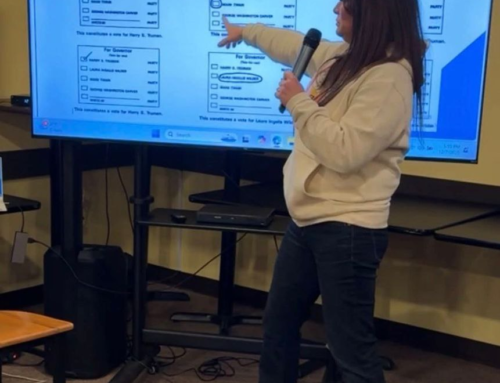
These machine rules determine which votes are counted, and election officials have confirmed that the tabulators reliably count only fully filled-in ovals.
A light mark, a checkmark, an “X,” or a hand written corrected choice is a legally valid vote under Missouri law—but unreadable to a machine. When that happens, the failure is not voter error. It is a technology limitation overriding a legal standard.
Missouri Law Assigns Counting to Judges, Not Software
Missouri paper ballot statutes repeatedly assign vote-counting duties to election judges, not tabulating equipment.
The law directs judges to open ballot boxes, count ballots, and record votes. It then requires those same judges to certify election results.
But in elections using automated tabulators, election judges do not count votes themselves. The machines count. Judges receive software-generated totals and are asked to sign off that the totals are accurate for all votes cast.
That is not a small procedural difference. It is a substitution of a statutory duty.
If the law requires election judges to tally votes, can that responsibility be transferred to software contradicting explicit statutory authorization?
Certification Without Counting Undermines Transparency
Certification is supposed to mean accountability. Judges certify results because they performed the count and can stand behind it.
When certification is based on machine totals instead of human counting, it becomes an act of trust—trust in software, calibration settings, and vendor logic that is unknown to election judges and voters.
Paper ballots counted by people are transparent. Anyone can watch the process. Anyone can understand how decisions are made.
Software-driven counting happens inside machines. It is not observable in the same way. And it is not sanctioned under Missouri’s paper-ballot laws.
This Isn’t Anti-Technology. It’s Pro-Law.
This debate is often framed as a matter of speed, efficiency, and monetary cost. That misses the point.
The issue is not whether technology is useful. The issue is whether the practice complies with the laws on the books.
Missouri election laws mandate people—not machines—interpret and count votes when using paper ballots.
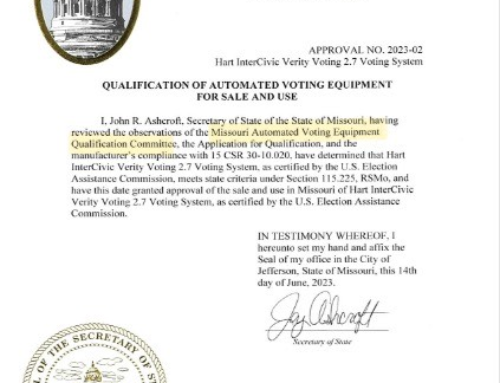
So, why is the Secretary of State approving the purchase and use of automated tabulating equipment that violate our election laws? Why is the Secretary of State silent when shown hard evidence of those violations?
Where is the accountability? Where is the transparency? Missourians will not ignore noncompliance with our election laws.
The arguments we’ve presented deserve public attention, legislative clarity, and honest debate—because election integrity is about ensuring accurate outcomes and about following the law!
Official Ballot
Casting A Vote
Counting Votes
Voter Intent
Certification
Verification
Tags: